The River Dart Calendar Project 2026 showcases the work of 13 emerging printmakers, the beauty and diversity of the river and the organisations and user groups that utilise the river.
Each printmaker had to work with a user group or organisation connected to the River Dart that reflected one month in the calendar year. Part of the Brief was to spend time on the river with the group to learn more about their activity/organisation and how they feel about their relationship to the river. Their final image should reflect this experience as well as their own personal reflections on the River Dart and its surrounding landscapes.
When Sally Sutton and I selected our final 13 printmakers, we made sure we had an interesting mix of styles and techniques. We have really enjoyed watching the printmakers respond to their individual briefs and been delighted by the finished images, which are a wonderful collaboration between the printmaker, the Dart and the river users.
The Month of May
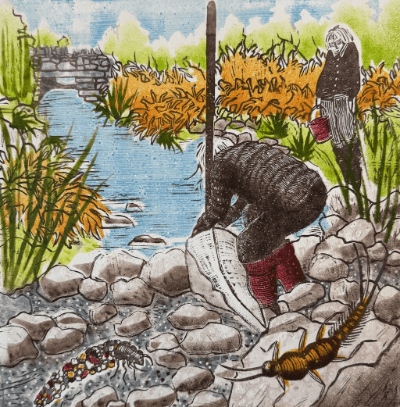
As one of the Printmakers, I was lucky enough to spend the day with the lovely Fly Data Collection Group.
Anna and Hillary call themselves citizen scientists and give their time to collect data that helps record the health of the river in terms of water-borne insect life, in particular Mayfly larvae and Caddis Fly larvae. They do this by taking water samples between May and September.
Material is collected by disturbing the river bed with their boots and using a tight-meshed net downstream to collect whatever has been disturbed. This activity is timed for three minutes. The contents are transferred to a bucket of river water and then to a wide, shallow tray, ready for inspection. Using identification guides, Hillary and Anna spend a couple of hours identifying the waterborne larvae and putting them in separate containers for counting later. The sample we had was teaming with life, and Hillary and Anna were pleased to find Mayfly larvae and Caddis fly larvae and Olivefly larvae.
They also do a boulder test, which is one minute long and involves overturning rocks in the river to see if there are any larvae clinging to them. We found many caddis larvae adhering to the rocks.
The River here is narrow, fast-flowing, but shallow. It had a peaty colour flowing over rocks and gravel beds. There was plenty of weed growing in the middle of the river, less on the edges. There were clumps of water marigolds in flower and water irises about to bloom. The riverbank was covered in gorse, which was a riot of sunshine yellow. A very beautiful spot
The river fly group samples various parts of the river, this being one of them. They sample the same part of the river each year.
Hillary describes herself as an Aunt to the river. She has lived on Dartmoor for 30 years and has a family connection that goes back decades.
Anna spends time undoing dams that are made by people spending time at the river’s edge. Although she loves that families/groups have a positive interaction with the river, she is mindful of the impact on the river itself when changes like damming happen
When asked what motivates them to be involved, they both said that the water quality of the river is good for humans, but more importantly, good for maintaining the biodiversity needed to have a healthy ecosystem.
They were both keen to express that they are doing this first and foremost for the health of the river, caring for the river, for nature itself.
It gives them purpose, and they both love to be by the river, in the landscape, enjoying nature.
Below, you can see a bit of my progress and my day out with the Fly data collection-
-

- Hillary and Anna collecting samples

-

- Sample handling

-

- Hillary and Anna sorting samples

-

- Final sketch

-

- Colour palette and Lino

-

- Mono printing colours

-

- Adding the blue layer

-

- Final Lino layer added